Stop 03 · Everyday Fit Notes
Sneakers With Chinos: Getting the Hem Right
Most sneaker-and-chino outfits fail in the last two inches of trouser. The hem lengths, leg openings, and roll widths that fix it, for low-tops and high-tops.
By Danny Reyes, Everyday Editor
· 7 min read · 1,506 words
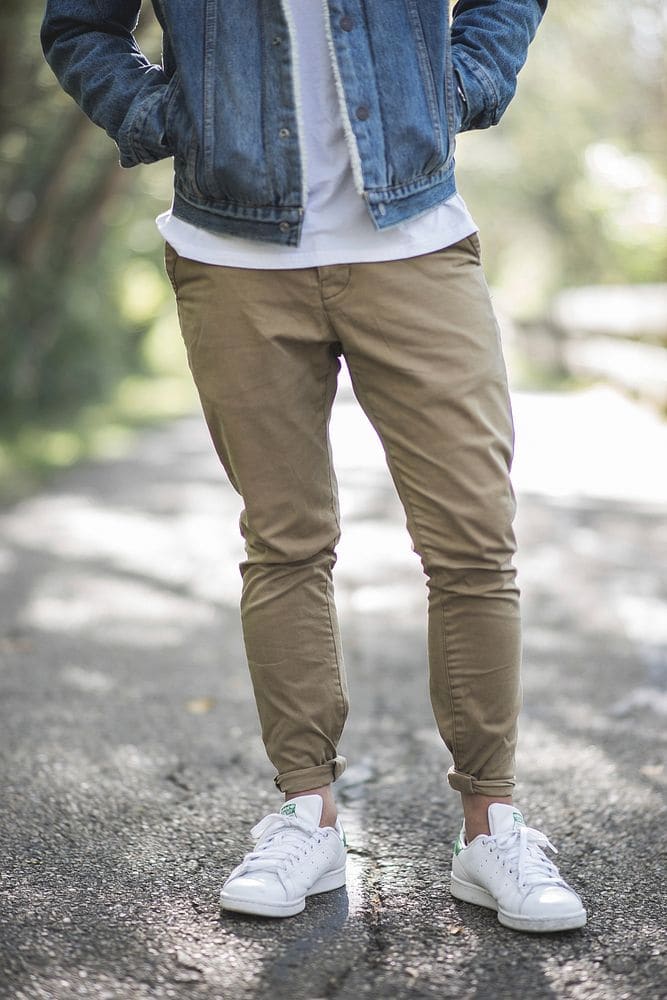
Stand sideways to a full-length mirror in your chinos and the sneakers you wear most, and look at the two inches of trouser just above the shoe. If the fabric folds onto the laces, or bells out over the sides, or sags into a little puddle at the heel, that’s the problem with the outfit. Not the shoe, not the color. The hem.
The fix is specific. To wear sneakers with chinos, hem them with no break, so the fabric just grazes the top of the shoe or ends up to half an inch above it, and taper the leg opening to roughly 6.75 to 7.25 inches for low-tops or 7.25 to 7.5 inches for high-tops. A roll or a short cuff is optional. A full break never works with sneakers.
I learned this the slow way. For years I wore chinos hemmed for dress shoes with sneakers on weekends, and every photo of me from that era looks like I’m standing in a shallow pool of khaki.
Sneakers with chinos need no break
Break is the fold a trouser makes when the hem lands on the shoe. A dress shoe has a long, low vamp, so a slight break can rest on it and look tidy. A sneaker is shorter and taller at the front, with a padded tongue and a chunky toe box, so any extra length has nowhere to go but sideways. It folds onto the laces and crumples.
So you want no break. The front of the hem should touch the top of the shoe, or sit up to half an inch above it, with no fold when you stand still. When you walk, a little sock will show. That’s fine. If you’re used to longer trousers it’ll feel short for about a week, then it’ll feel right, and your old pairs will start to look sloppy.
One caveat on slant. Some tailors cut the back of the hem a quarter inch longer than the front so it covers the heel. On dress trousers I like that. On chinos for sneakers I skip it, because the back of a sneaker is tall and padded, and the extra length just bunches against the heel tab.
There’s a whole vocabulary for this on tailored trousers, and choosing between none, slight, and full break covers it properly. With sneakers you can skip most of it. None is the answer.
If the hem is touching your laces, it’s too long.
The leg opening matters as much as the length
You can hem a pair perfectly and still get it wrong if the leg is too wide. A 9-inch opening sitting on a slim white sneaker hides most of the shoe and makes the whole leg look like a tube. Too narrow, under about 6.5 inches, and the hem catches on the tongue and rides up when you sit.
The leg opening is measured flat across the hem, side to side. These are the numbers I use, and they line up with measuring rise, seat, and taper from the waist down.
| Sneaker | Leg opening | Hem position |
|---|---|---|
| Slim leather low-top | 6.75–7 in | Grazing the shoe |
| Canvas low-top | 7–7.25 in | Grazing or 1/2 in above |
| Canvas high-top | 7.25–7.5 in | Rolled to top of shoe |
| Chunky runner | 7.5–8 in | Grazing, slight stack OK |
If your chinos are wider than this, a tailor can taper from the knee down for around $25 to $40. Hemming on its own usually costs $15 to $25. Have it done after the first wash and dry, because cotton twill can shrink close to an inch in length in a hot dryer, and a perfect no-break hem becomes a high-water hem overnight.
Low-tops are the strict case
A clean white leather low-top is the sneaker that pairs most naturally with chinos, and it’s the least forgiving about the hem, because the shoe is low and slim and every extra fold shows.
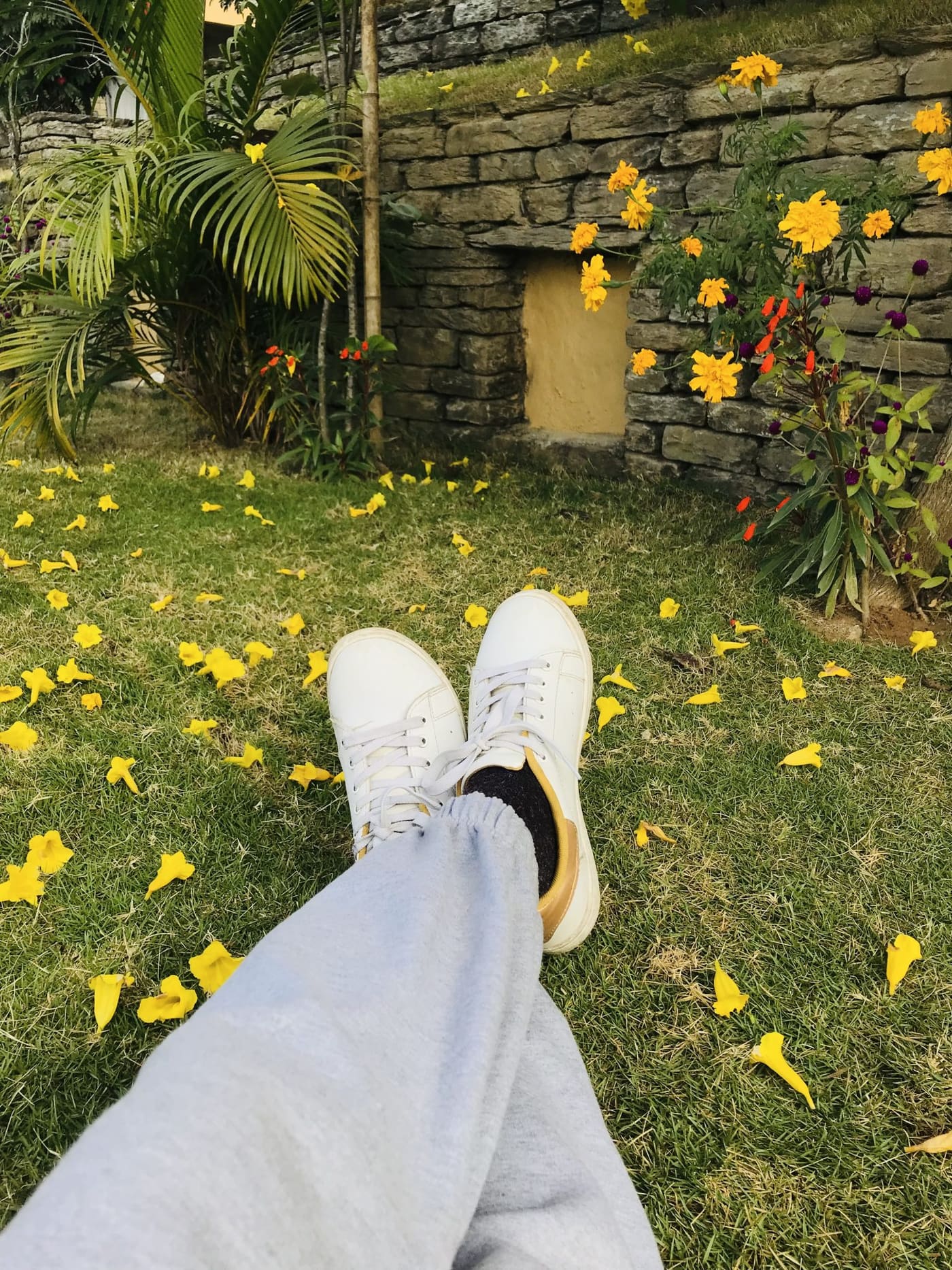
The one I wear is the Common Projects Achilles Low, at $450. It’s a minimal white leather sneaker on a stitched rubber cupsole, and it reads as clean with a navy jacket as it does with olive chinos on a Sunday. I’ll be straight about the price. You’re paying mostly for the leather and the finish rather than for construction; the cupsole is stitched, but it isn’t something a cobbler will rebuild for you the way a welted boot can be. And white leather shows every crease and scuff. Mine had a deep flex crease across the toe within three weeks, and I spent a while being annoyed about it before deciding it gave the shoe some character. How white leather sneakers age is worth reading before you spend that much.
With a shoe like this, I hem chinos so the front just touches the top of the shoe, with a 6.75 to 7-inch opening. No roll. A slim low-top with a clean plain hem is the sharpest version of sneakers with chinos, and it’s what I wear when the outfit has to work at dinner afterward, or on a first date, where dressing without overtrying is the whole game.
Color is the easy part once the hem is right. White sneakers go with every chino color I own: khaki, olive, navy, gray, and stone. Darker canvas narrows the field a bit. Black Chucks with khaki chinos look like a school uniform to me, though plenty of people pull it off. If you own only one pair of sneakers to wear with chinos, make it white.
High-tops play by different rules
A high-top covers the ankle, so the hem has to deal with a shoe that’s 5 or 6 inches tall instead of 2 or 3. You have two clean options: hem the chinos short enough to sit right at the top of the shoe, or roll them so they stop there.
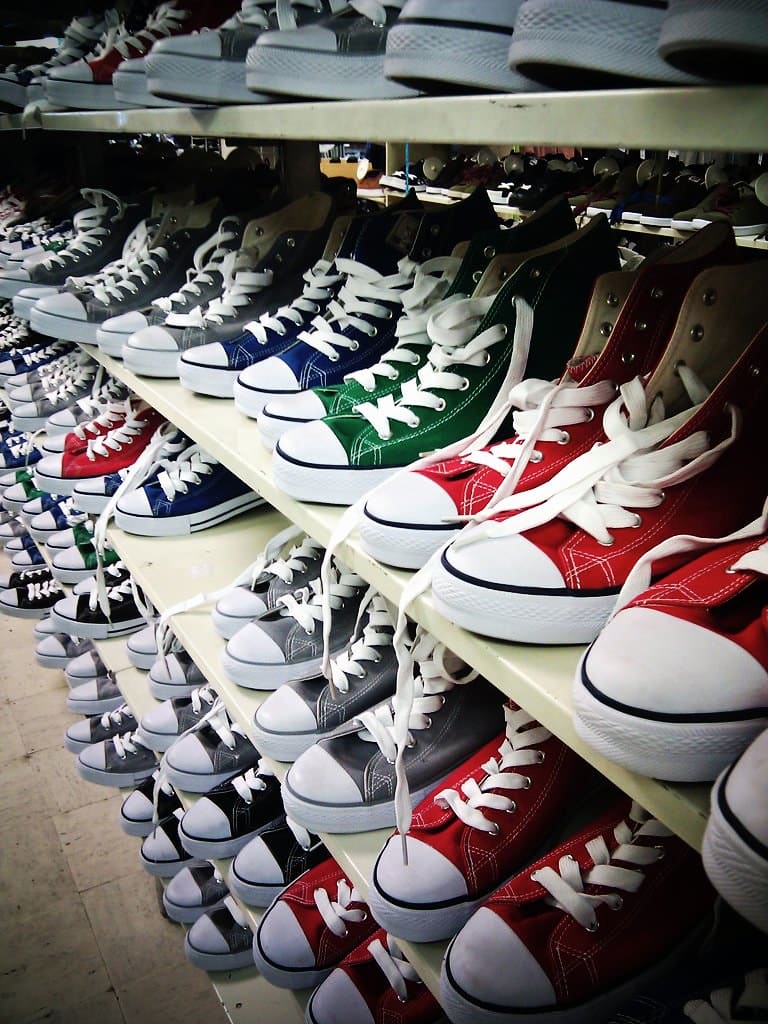
My high-top is the Converse Chuck 70 Hi, which costs $90. It has heavier canvas than the standard Chuck, a taller rubber foxing, and a cushier insole, and it looks right with chinos in a way plenty of high-tops don’t, because the profile is slim. The downsides: there’s almost no arch support for long days on your feet, and the canvas soaks through in the first real rain. I wear them for short weekend days and keep something sturdier for anything involving a lot of walking.
With Chucks, I like a 7.25 to 7.5-inch opening and a single roll that ends right at the top edge of the shoe. If the hem stacks on top of the high-top, the shoe disappears and your legs look short. If it ends an inch above, you see a strip of sock, which can look fine in summer with the right sock. My hard rule is no fabric resting on the shoe. Chucks are also the backbone of my weekend uniform, which is half the reason I’ve thought about this so much.
Roll, cuff, or plain hem
You don’t have to tailor every pair. A roll is a free, reversible way to shorten chinos for sneakers, and it adds a casual note that suits canvas shoes.
| Hem option | Width | Best with |
|---|---|---|
| Plain hem, no break | None | Leather low-tops |
| Single roll | About 1–1.25 in | Canvas low-tops, high-tops |
| Pinroll (tapered roll) | About 1 in | Wide openings over 7.5 in |
| Sewn cuff | 1.25–1.5 in | Heavier chinos, canvas shoes |
Keep rolls neat and narrow. A roll wider than about 1.5 inches starts to look like you waded across a creek. Two narrow rolls are fine; three is a costume. If your chinos are too wide in the leg, a pinroll can fake a taper: pinch the excess at the inside seam, fold it flat against the leg, then roll twice.
Sock choice follows from all this. With no break, your socks will show when you walk, so either go with no-show socks for a bare-ankle look in summer, or pick a sock in a color that relates to the trousers or the shoe. White athletic socks with white sneakers and chinos can work in a deliberately sporty way. Black dress socks with sneakers almost never do.
If you’re getting a pair hemmed for sneakers, the routine is short:
- Wash and dry the chinos once, the way you’ll keep washing them.
- Bring the sneakers you’ll wear most with them.
- Have the tailor pin the hem so the front just grazes the shoe with no fold.
- Walk across the room and sit down; if the hem catches on the tongue, take off another 1/4 inch.
More hem-and-shoe pairings like this one live in the everyday archive.
The verdict: Hem your chinos with no break so the front just touches or sits up to half an inch above the shoe, and taper the opening to 6.75 to 7 inches for a slim leather low-top like the Common Projects Achilles Low or 7.25 to 7.5 inches with a single roll for a high-top like the Converse Chuck 70 Hi. Wash before you hem, and never let fabric rest on the laces.
In this story
How we make money: some links below are affiliate links. If you buy through them, Via may earn a commission. It never changes the price you pay, and it never decides what we recommend. Full disclosure.
Investment · $300+
Common Projects Achilles Low
A minimal white leather sneaker with a stitched rubber cupsole that reads clean with tailoring as easily as with denim.
Won't do: You pay mostly for leather and finish rather than construction, and white leather shows every crease and scuff.
Entry · under $100
Converse Chuck 70 Hi
Heavier canvas, a taller rubber foxing, and a cushier insole than the standard Chuck; a weekend shoe that costs less than a nice dinner.
Won't do: Almost no arch support for long days on your feet, and the canvas soaks through in the first real rain.
Next stops
All Everyday guides
Chinos That Fit: Rise, Seat, and Taper
Most chinos fail in three places: where the waist sits, how the seat drapes, and how the leg narrows to the shoe. How to measure each one.
Danny Reyes 9 min
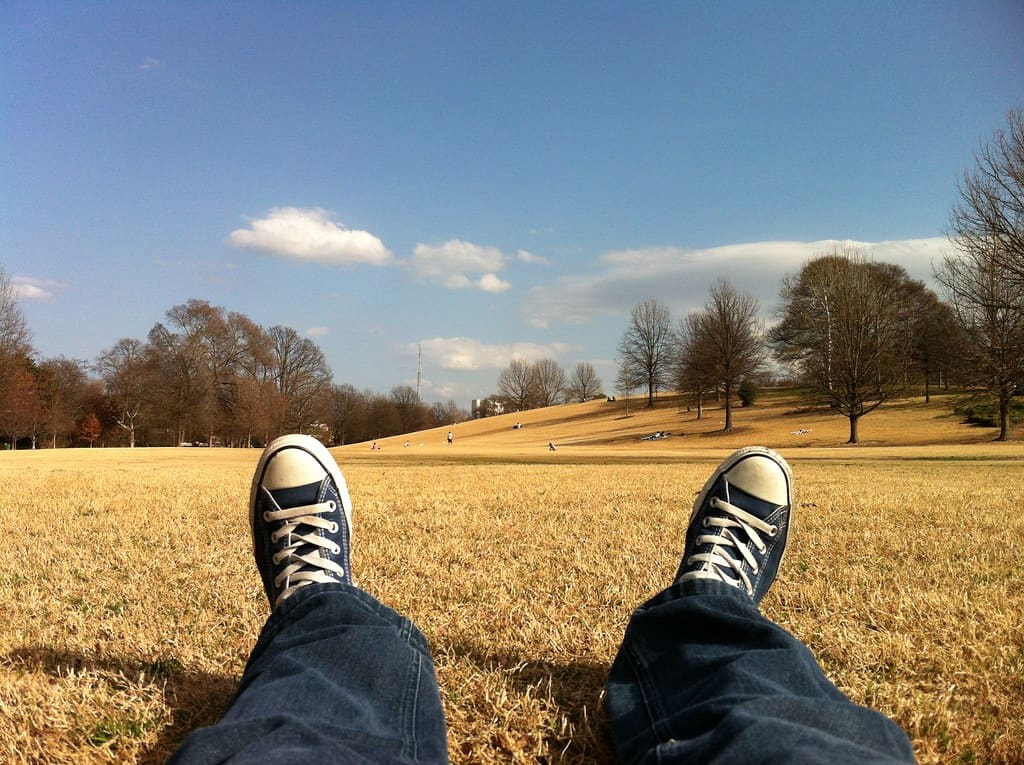
Building a Weekend Uniform You Won't Get Tired Of
Fix the formula, rotate the parts: a two-shoe weekend uniform that survives a year of Saturdays without turning into the same photo every week.
Danny Reyes 7 min
Belt Sizing: Why Your Belt Isn't Your Waist Size
A belt is measured from the buckle fold to the center hole, not around your body, and that one length is the only number worth trusting.
Theo Lindqvist 5 min